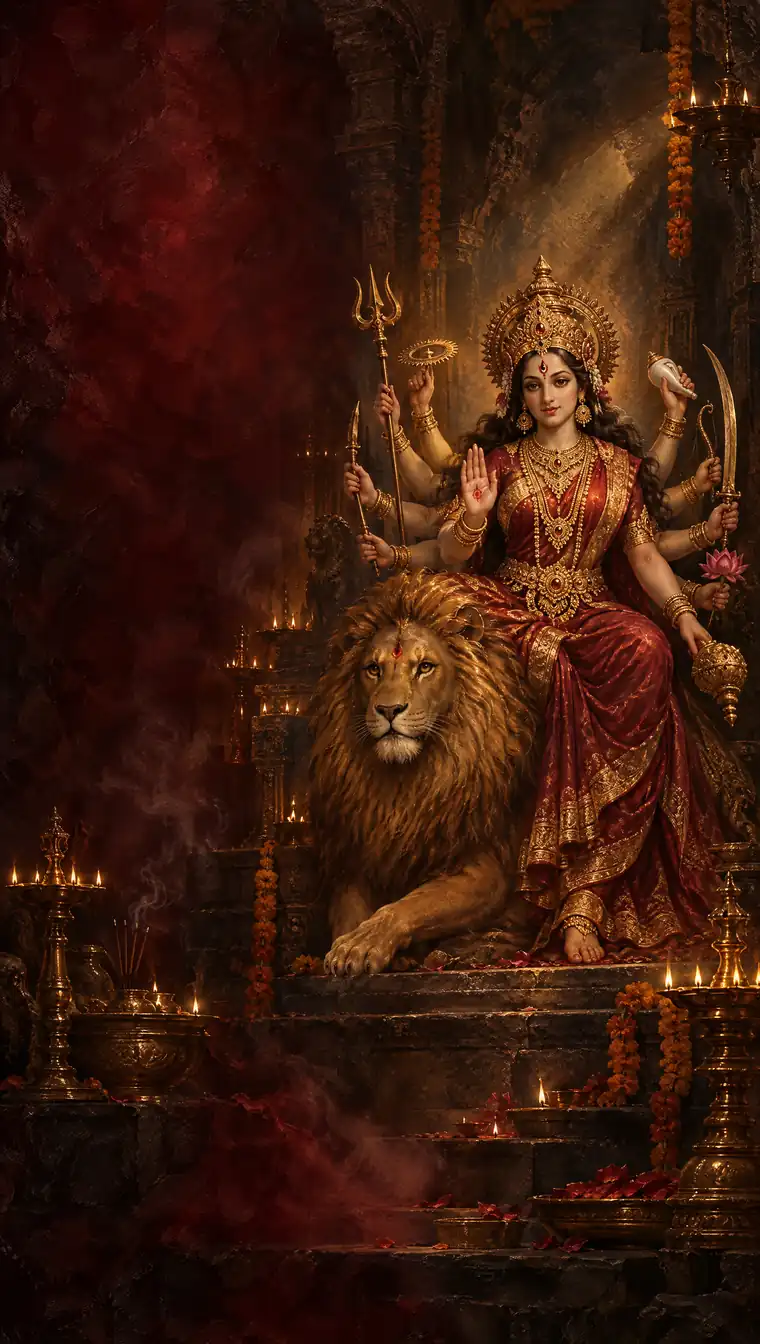
Goddess Durga
Aigiri Nandini (Mahishasura Mardini Stotram)
The rousing hymn to the Goddess who vanquished Mahishasura.
Begin chantingMeaning & traditionअयि गिरिनन्दिनि नन्दितमेदिनि विश्वविनोदिनि नन्दिनुते
O daughter of the mountain, who gladdens the earth and delights the universe, praised by Nandi;गिरिवरविन्ध्यशिरोऽधिनिवासिनि विष्णुविलासिनि जिष्णुनुते ।
dwelling on the peak of the great Vindhya range, delight of Vishnu, praised by Indra;भगवति हे शितिकण्ठकुटुम्बिनि भूरिकुटुम्बिनि भूरिकृते
O blessed Goddess, wife of blue-throated Shiva, mother of a vast family, doer of great deeds:जय जय हे महिषासुरमर्दिनि रम्यकपर्दिनि शैलसुते ॥
victory, victory to you, slayer of Mahishasura, with beautiful braided hair, daughter of the mountain.अर्थ
हे पर्वतराज की पुत्री, पृथ्वी को आनन्द देने वाली, संसार को प्रसन्न करने वाली, नन्दी द्वारा स्तुत, विन्ध्य पर्वत के शिखर पर वास करने वाली, विष्णु को आनन्दित करने वाली, इन्द्र द्वारा स्तुत, नीलकण्ठ शिव की पत्नी, विशाल परिवार वाली, महान कार्य करने वाली भगवती, महिषासुर का वध करने वाली, सुन्दर जटाओं वाली शैलपुत्री, आपकी जय हो, जय हो।
Ayi girinandini nanditamedini viśvavinodini nandinute
O daughter of the mountain, who gladdens the earth and delights the universe, praised by Nandi;Girivaravindhyaśiro’dhinivāsini viṣṇuvilāsini jiṣṇunute
dwelling on the peak of the great Vindhya range, delight of Vishnu, praised by Indra;Bhagavati he śitikaṇṭhakuṭumbini bhūrikuṭumbini bhūrikṛte
O blessed Goddess, wife of blue-throated Shiva, mother of a vast family, doer of great deeds:Jaya jaya he mahiṣāsuramardini ramyakapardini śailasute
victory, victory to you, slayer of Mahishasura, with beautiful braided hair, daughter of the mountain.Meaning
O daughter of the mountain, who gladdens the earth and delights the universe, praised by Nandi; dwelling on the peak of the great Vindhya range, delight of Vishnu, praised by Indra; O blessed Goddess, wife of blue-throated Shiva, mother of a vast family, doer of great deeds: victory, victory to you, slayer of Mahishasura, with beautiful braided hair, daughter of the mountain.
Ayi girinandini nanditamedini vishvavinodini nandinute
O daughter of the mountain, who gladdens the earth and delights the universe, praised by Nandi;Girivaravindhyashirodhinivaasini vishnuvilaasini jishnunute
dwelling on the peak of the great Vindhya range, delight of Vishnu, praised by Indra;Bhagavati he shitikanthakutumbini bhoorikutumbini bhoorikrite
O blessed Goddess, wife of blue-throated Shiva, mother of a vast family, doer of great deeds:Jaya jaya he mahishaasuramardini ramyakapardini shailasute
victory, victory to you, slayer of Mahishasura, with beautiful braided hair, daughter of the mountain.Meaning (Hinglish)
He parvatraaj ki putri, prithvi ko aanand dene vaali, sansaar ko prasann karne vaali, Nandi dvaaraa stut, Vindhya parvat ke shikhar par vaas karne vaali, Vishnu ko aanandit karne vaali, Indra dvaaraa stut, Neelkanth Shiva ki patni, vishaal parivaar vaali Bhagvati, Mahishaasur ka vadh karne vaali, sundar jataaon vaali Shailputri, aapki jai ho, jai ho.
First verse of the Mahishasura Mardini Stotram, traditionally attributed to Adi Shankaracharya (the attribution is debated). The hymn has about twenty verses; only the first is shown. English meanings are paraphrases; punctuation and Devanagari spelling are normalized.
Your daily mala
One chant, one bead.
Saved on this device. Return whenever you’re ready.
About the Aigiri Nandini
Aigiri Nandini, the Mahishasura Mardini Stotram, praises the Goddess as the daughter of the mountain who defeated the buffalo demon Mahishasura. Its rolling rhythm and refrain, “jaya jaya he mahiṣāsuramardini”, make it a favourite of Navratri and Durga Puja.
Best time to chant: Navratri and Durga Puja, especially Mahalaya and Vijayadashami, and on Tuesdays and Fridays.
Benefits of the Aigiri Nandini
- The rousing hymn to the Goddess who vanquished Mahishasura.
- Repeated recitation can be used as a practice of attention and devotion.
How to chant the Aigiri Nandini
- Read each line together with its meaning before beginning.
- Recite the complete prayer slowly, following the script you prefer.
- Use the counter after each complete recitation. Choose a comfortable number of repetitions.
Frequently asked questions
Where does Aigiri Nandini come from?
First verse of the Mahishasura Mardini Stotram, traditionally attributed to Adi Shankaracharya (the attribution is debated). The hymn has about twenty verses; only the first is shown.
What does one count represent?
One count represents one complete recitation of the prayer displayed on this page. You can choose a short practice or count 108 repetitions.